Contractor Self-Billing Software and How Agency Billing Works
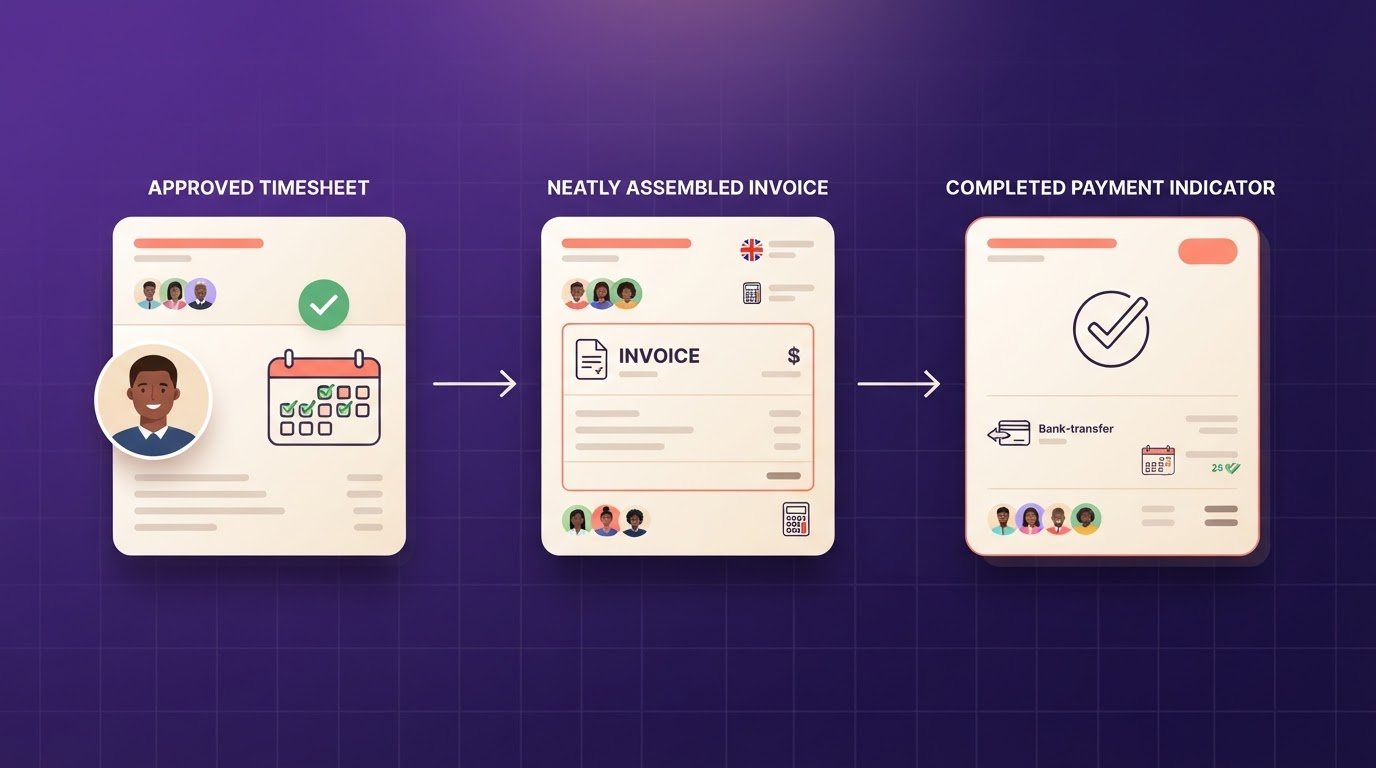
Self-billing changes who prepares the invoice, not the need for an agreed process. In a typical UK agency arrangement, the contractor submits timesheets and expenses, and the agency prepares an invoice using the approved information. Contractor self-billing software for recruitment agencies helps organise this part of agency billing.
Self-billing can simplify invoicing, but the terms matter. UK Government guidance says a self-billing agreement must state that the supplier will not issue VAT invoices for the supplies it covers and will accept each self-billed invoice.
This article explains what self-billing means, how agencies handle timesheets, invoices and payments, and what contractors agree to before the arrangement begins. It also explains how VAT status and umbrella companies fit into the process.
- See how approved shift records and agreed rates support agency billing.
- Understand how contractors, agencies and umbrella companies fit into the payment process.
- Identify the agreement details that help keep billing responsibilities clear.
- Consider how software can bring staffing agency tasks into a more organised workflow.
What is self-billing?
Self-billing is an arrangement in which the recruitment agency prepares invoices for a contractor’s supplies. In the UK, the contractor submits timesheets and expenses, and the agency uses approved information to prepare the invoice.
Generating invoices from approved timesheets
The agency applies the agreed rates to approved hours and accepted rechargeable expenses. The invoice records the work for the period covered by the timesheet, linking payment to authorised shifts rather than to an invoice issued by the contractor.
For contractor self-billing software, compare how each option handles timesheet approval, rate records, invoice creation, integrations and support. Those criteria show whether the system fits your billing process; available integrations and support arrangements vary by provider.
VAT details on self-billed invoices
A self-billed invoice identifies the contractor and includes VAT details where applicable. It records the contractor’s name, company name, registered office address and VAT registration number, if applicable. A VAT invoice must also include the supplier’s name, address and VAT registration number, alongside the other details required for a full VAT invoice.
UK Government guidance says the agreement must state that the supplier will not issue VAT invoices for covered supplies and will accept each self-billed invoice. A VAT-registered contractor should provide the agency with its VAT number and certificate, and tell the agency if it deregisters.
Contractor checks and agency payments
The agency prepares the invoice and sends the contractor a copy with payment, according to UK Government guidance. Contractors should compare each invoice with approved timesheets, agreed rates and submitted expenses, including any VAT calculation.
A limited company records the self-billed invoice in its accounts and links it to the relevant work and payment remittance. An umbrella-company arrangement differs: the agency sends the self-billed remittance to the umbrella company, which pays the contractor.
Self-billing risks and compliance mistakes
Common errors include billing unapproved hours, applying the wrong rate, using outdated VAT details or issuing a separate VAT invoice for supplies already covered by self-billing. These mistakes can leave the invoice, payment and accounts out of step.
Contractors should check invoices against timesheets, expenses and payments received. If the supplier is no longer VAT registered, the agency should stop issuing VAT self-billed invoices. This keeps the invoice trail aligned with the supplier’s current VAT status.
How self-billing works for recruitment agencies
The agency’s process connects approved shift records with billing and payment. The fee-payer arrangement and the contractor’s VAT status determine how the process works.
Handling VAT and contractor payments
Self-billing software supports this workflow by keeping timesheets, expenses and invoice information together. The agency uses approved records and agreed rates to prepare the contractor’s invoice, rather than waiting for a separate invoice.
For a VAT-registered company, the agency adds VAT to the self-billed invoice and pays it to the company. The invoice should use the supplier’s current VAT details. If the supplier is an umbrella company, the agency sends the self-billed invoice and payment to the umbrella company, which pays the contractor.
Who is responsible for payment can affect the process. If the end-client is the fee-payer, the agency may not produce and pay the invoice in the same way. Make the responsible payer clear in the workflow so approved hours, expenses and payment records can be traced together.
Moving from manual invoicing
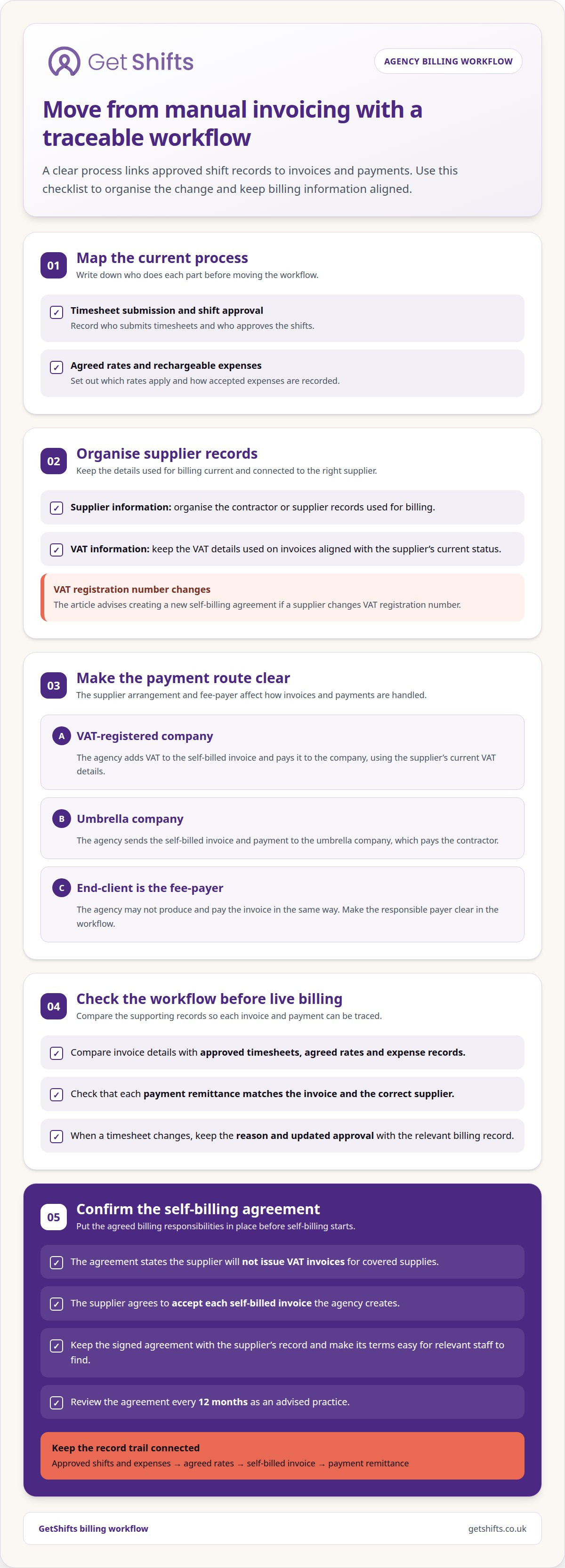
Before moving from manual invoices to software, document the existing approval and payment process. Map who submits timesheets, who approves shifts, which agreed rates apply and how rechargeable expenses are recorded.
Next, organise contractor and supplier records, including the VAT details used for billing. Set out how the agency handles an umbrella company and who pays when the end-client is the fee-payer. This gives staff a consistent process instead of relying on separate spreadsheets, email threads or paper records.
Before using the new workflow for live billing, compare invoice details with approved timesheets, agreed rates and expense records. Check that each payment remittance matches the invoice and the correct supplier. When a timesheet changes, keep the reason and updated approval with the relevant billing record so the agency can explain any difference later.
For a UK VAT-registered company under a self-billing arrangement, the agency must add VAT to the self-billed invoice and pay that VAT to the company.
Self-billing agreements between recruitment agencies and contractors
A formal agreement must be in place before a UK agency starts self-billing for a contractor. It sets out how invoices are created and accepted, giving both parties a clear billing process before shifts begin.
UK Government guidance and legislation.gov.uk say the agreement must state that the supplier will not issue VAT invoices for covered supplies and will accept each self-billed invoice the agency creates. This helps prevent duplicate invoices for the same supply and clarifies responsibility for invoice creation.
The agency should explain its process when the contractor or umbrella company signs its terms and conditions. Cover how timesheets are submitted and approved, how expenses are recorded, when invoices are produced and how payment is made. Clear terms help contractors understand what to submit and what to expect.
Review the agreement every 12 months as an advised practice. If a supplier changes VAT registration number, the agency should create a new agreement. Keep supplier details aligned with the agreement, so the invoice process reflects the correct company and VAT information.
What should recruitment agencies look for in contractor self-billing software? Choose tools that connect supplier agreements and VAT records with approved timesheets, invoice information and payment records. A clear amendment history also helps staff trace changes to a shift or invoice.
For practical administration, keep each signed agreement with the supplier’s record and make its terms easy for relevant staff to find. If a contractor queries an invoice, the agency can refer to the agreed process and supporting timesheet. If VAT details change, update the supplier record and arrange a replacement agreement before relying on the old details.
Contractors should understand that self-billing means the agency prepares invoices for covered supplies. Under the agreement, they will not issue separate VAT invoices for those supplies and will accept each self-billed invoice. This shared understanding helps prevent duplicate billing and clarifies the working relationship.
What is contractor self-billing software for UK recruitment agencies?
Contractor self-billing software helps an agency prepare and manage invoices for contractors under an agreed self-billing arrangement. It brings billing records into a digital workflow, rather than relying on separate spreadsheets, emails and manually prepared documents.
For example, after a care home approves a contractor’s timesheet, the agency can use the approved hours and agreed rate as the basis for billing. The software should keep the shift record connected to the invoice details, so staff can trace how the billed amount was calculated.
Consider how the system handles exceptions as well as routine invoices. A changed timesheet, disputed expense or updated supplier detail can affect billing. An amendment history that records changes and reasons helps staff understand what changed and which record informed the invoice.
Start with the agency’s actual process when choosing software. Check whether the workflow can represent contractor and umbrella-company arrangements, store relevant supplier details and produce records that staff can reconcile against payments. It should also be clear which timesheet has been approved and which invoice relates to it.
Consider how billing information moves between operational tasks. If timesheets and invoices are in separate systems, staff may need to copy details and resolve mismatches manually. Review how the software handles your existing records and exports, then test a routine shift and an amended shift before adopting the process.
For a UK agency, useful software supports accurate records; it does not replace the signed agreement or the contractor’s invoice checks. Your process still needs clear approval, current supplier information and a way to review invoice figures. These controls matter in care, security, hospitality and other sectors where workers serve different clients.
To see how agency billing workflows can be organised, explore invoicing software for agencies.
Get Shifts: Staffing Agency Management Software
Get Shifts provides staffing agency management software for organising bookings, worker records and agency operations. It gives your team a central place to manage the practical work behind temporary staffing.
A client booking portal lets care homes, hospitals and other clients place staff requests. Workers can use the mobile app, while the candidate portal and branded job board support your agency’s recruitment workflow.
These tools bring client requests, worker information and candidate activity into a clearer agency process. Your team can see how the platform fits the way you manage staffing.
Make your next billing decision count
Use your current workflow to judge whether new software will support your agency’s operations. Map how shift booking, timesheet approval and billing pass between team members. This helps you identify practical gaps a system needs to address, rather than choosing from a feature list alone.
When assessing contractor self-billing software for recruitment agencies, consider how billing fits alongside the wider agency workflow. Get Shifts offers Staffing Agency Management Software, including Shift Booking & Rota Management and Open Shift Broadcasting to Eligible Workers.
If you’re ready to explore whether Get Shifts suits your agency’s workflow, contact Get Shifts to discuss your needs. A clear view of your process is a useful place to start.
Frequently Asked Questions
What if my company is VAT-registered?
A VAT-registered company can use self-billing, provided its VAT details are handled correctly. Make sure the agency has the company’s current VAT registration details, and update the billing arrangement if the registration changes. Reconcile self-billed invoices with the company’s records and payment remittances so any difference in VAT or amounts is visible during bookkeeping.
Which UK self-billing software platforms are designed for recruitment agencies?
Get Shifts offers contractor self-billing within its staffing agency management software. Self-billing can be enabled per worker, allowing an agency to apply the process to relevant contractor records. The platform also exports invoice and earnings data to CSV or Excel for manual import into accounting or payroll software. It does not provide a direct accounting-package integration or payroll processing service.
What HMRC rules and VAT requirements apply to self-billing agreements?
UK self-billing arrangements need a written agreement covering the supplies involved. The UK Government states that the supplier must agree not to issue VAT invoices for those supplies and to accept each self-billed invoice. VAT invoices need the supplier’s details and the required information for a full VAT invoice. See the UK Government VAT invoice guidance for current requirements.
How do agencies set up self-billing agreements with contractors and suppliers?
Build the agreement into supplier onboarding before self-billing begins. Record the supplier’s legal and VAT details, identify the work covered by the arrangement, and explain how timesheets, expenses, invoices and remittances fit together. For an umbrella-company contractor, record the umbrella company as the supplier for the arrangement. Keep the signed agreement accessible to staff who handle billing queries and supplier changes.