Improve staffing agency shift fill rates with a private worker pool

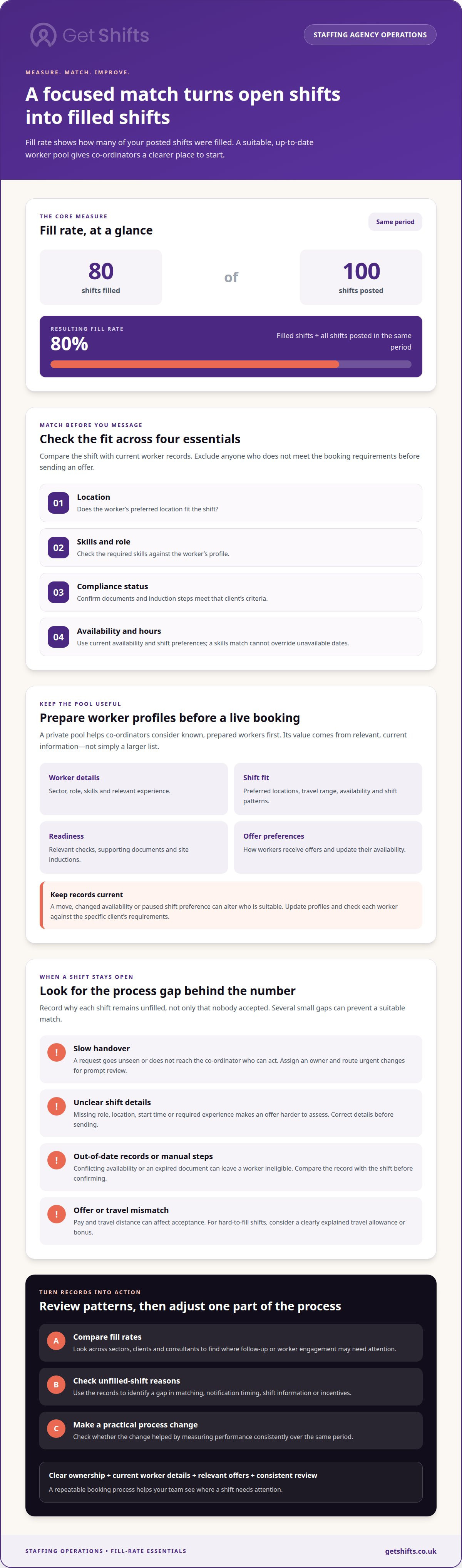
A stronger fill rate starts with a pre-vetted pool of workers whose availability, skills, location and compliance status match the shift. To improve staffing agency shift fill rates, send suitable offers to that pool and track how many posted shifts are filled. If you fill 80 of 100 posted shifts, your fill rate is 80%.
It’s frustrating when a shift stays open despite a long list of workers. The issue is often not the size of your pool, but whether suitable workers see a clear offer in time. A consistent booking process makes that easier to manage.
This guide explains how to build a focused pool of prepared workers, identify common causes of unfilled shifts and improve matching. It also shows how to compare fill rates across sectors, clients and consultants to spot where follow-up or worker engagement needs attention.
- Choose a clear owner for each open-shift request so nothing is missed between the client and co-ordinator.
- Give workers a simple way to share changes that affect the shifts they can accept.
- Use consistent booking outcomes so your reports reflect the same stages across teams.
- Turn review findings into one practical process change, then check whether it helped.
1. How can I improve shift fill rates in my staffing agency?
Start with a clear match, not a broad message to every worker. Compare the shift’s location, required skills, compliance status and hours with current worker records. For example, a care-home night shift calls for someone with the relevant skills, valid documents and availability. Exclude anyone who does not meet the booking requirements before sending an offer.
Keep availability current. Use recorded preferences and client requirements to narrow the eligible group. Relevant offers are easier for workers to assess and can reduce avoidable declines.
Matching tools can help rank eligible workers against shift criteria. Use automatic allocation only when every required condition is met and the process is clear. Otherwise, send suitable matches to a co-ordinator for review. A skills match must not override unavailable dates or an expired compliance document.
Notify the matched group promptly. Push notifications can bring an offer to workers’ attention, while clear details help them decide. Include the role, location, start and finish times, required skills and how to respond. If the shift remains open, flag it for follow-up rather than assuming workers saw the offer.
There is no single response time for every shift request. Respond as soon as possible, prioritising by start time, urgency and suitable worker availability. An imminent care shift needs attention sooner than a repeat booking with more time.
UK rules on shift bookings, cancellations and temporary-worker pay depend on worker status, contractual terms and the arrangement. Check current GOV.UK guidance when reviewing those terms, and do not assume one rule applies to every worker.
For hard-to-fill shifts, consider bonus pay, travel allowances or priority for future bookings. State any incentive and its conditions clearly in the offer so workers can assess it accurately.
Measure performance consistently by comparing filled shifts with all shifts posted in the same period. Review unfilled requests by reason, then adjust matching criteria, notification timing or incentives when the records indicate a gap.
2. Building a private pool of pre-vetted flexible workers
A private pool gives your co-ordinators a known group to consider before advertising a shift more widely. Prepare workers before shifts become available by completing relevant background checks, right-to-work checks and site inductions. This keeps preparation separate from the pressure of a live booking.
Start with a profile for each worker. Record their sector, role, skills, preferred locations, availability and shift preferences. For example, distinguish a nurse available for nights from a care assistant seeking daytime work. These details help narrow the pool without sending unsuitable offers.
Keep compliance records with each worker’s profile. Note which documents or induction steps apply to each client or role, and whether they are current. Before offering a care-home shift, check the worker against that client’s booking criteria. Meeting one client’s requirements does not establish that every other client’s requirements are met.
Use a consistent enrolment process so co-ordinators collect the same useful information. It can include:
- Role, skills and relevant experience for the sector.
- Preferred locations, travel range and available shift patterns.
- Completed checks, supporting documents and site inductions.
- How the worker wants to receive offers and update availability.
Review profiles when workers change their availability, location or preferences. A worker who has moved may suit a different client; someone who has paused night work should no longer receive night-shift offers. Ask workers to update their details through a clear process, then use the latest information for matching.
Keep the pool useful, not merely large. Group workers by meaningful criteria, such as care role, location and client induction, then check that each group has enough suitable people for likely demand. This gives co-ordinators a practical shortlist and shows where more enrolment could help. A focused pool makes offers more relevant and easier to manage.
3. Common causes of unfilled shifts
An open shift can reflect several small process gaps, not just a shortage of workers. Slow internal responses, outdated availability, expired documents, unclear shift details, manual processes and low engagement can all prevent a suitable match. Track why each shift remains open, rather than recording only that nobody accepted.
Check how quickly a new request reaches the person who can act. A care home may email a late change while a co-ordinator is working through calls. If the request goes unseen, suitable workers have less time to accept it. Assign an owner to incoming requests and route urgent changes for prompt review.
Review shift details from a worker’s perspective. Missing information about the role, location, start time or required experience can make an offer difficult to assess. For example, “care shift tomorrow” is less clear than a named care-home location, a specific role and exact shift times. Correct errors before sending the offer.
Manual processes create another weak point. Copying availability between a spreadsheet and rota can leave conflicting records, while an expired document can make a worker ineligible. Compare the worker’s record with the shift before confirming a booking, and record the reason for any decline or failed match.
To reduce cancellations and no-shows, confirm the shift details and acceptance with the worker, and keep communication open if anything changes. If someone cancels, record the reason and begin contacting replacements promptly. Repeated patterns can show whether notice, location or shift information needs attention.
Pay and travel distance both affect whether a worker accepts. A longer journey may make a shift less practical, even when the role suits their skills. Review the stated pay alongside location and travel expectations. For hard-to-fill shifts, consider a travel allowance or bonus and explain the terms clearly.
Low engagement can also leave offers unanswered. Review who receives each message, whether the details are clear and how easily workers can respond. If a shift attracts little interest, contact other eligible workers and note what change brought a response. These records help distinguish a matching problem from a communication or offer issue.
4. Monitoring fill rates by sector, client and consultant
An agency-wide figure can hide where bookings are being lost. Break results down by sector, client and consultant, then compare similar shifts. A strong overall result may conceal weaker performance in nursing nights or one care-home account.
There is no single fill-rate target that suits every UK agency. Set a benchmark using your own past results, client commitments and the types of shifts you cover. Review trends over time rather than judging a consultant or sector by one unusual week.
Calculate the rate consistently: divide shifts filled by shifts posted, then multiply by 100. Use the same definition in every report. Record whether “filled” means accepted, confirmed or attended, as each measure answers a different operational question.
Use the same breakdown for each review:
- Sector: compare care, security, hospitality, cleaning, logistics and office shifts.
- Client: identify accounts with repeated declines or short-notice requests.
- Consultant: compare workloads, follow-up and handling of open shifts.
Investigate the pattern behind a gap. If one care-home client has lower results, examine request notice, location and booking details. If nursing nights lag across several clients, review how many suitable workers are available for those shifts. If results differ by consultant, compare follow-up practices and how work is prioritised.
Track no-shows separately from unfilled shifts. A no-show means a worker accepted but did not attend, so combining it with unfilled requests hides distinct problems. Record the shift, client, consultant and outcome, then compare no-shows with cancellations and replacement cover.
Review these breakdowns regularly and connect each finding to an action. For example, improve client request details, adjust the pool for a sector or change how consultants prioritise open shifts. Recheck the same measures after each change to see whether it addressed the weak point or whether another part of the booking process needs attention.
Get Shifts: Staffing Agency Management Software
Get Shifts brings shift booking, rota management and open-shift broadcasting together for staffing agencies. If calls and messages make offers difficult to coordinate, broadcast open shifts to eligible workers and give them access to the worker mobile app on iOS and Android.
This helps your team manage offers and bookings in one place, with the process focused on workers eligible for each shift. Get Shifts supports agency operations; it does not supply temporary staff or place candidates.
If you’re ready to bring shift booking and worker offers into a clearer workflow, book a demo with Get Shifts.
Turn your next improvement into a practical routine
Better shift coverage comes from consistent operational choices, not one-off fixes. To improve staffing agency shift fill rates, choose one part of your booking process to strengthen first. Assign clear ownership, define what success looks like and record what the team learns as it puts the change into practice.
This approach helps you respond to changing demand without treating every open shift as a separate emergency. Keep the process workable for co-ordinators and workers, then refine it as your agency’s needs develop. Deliberate adjustments make the next steps clearer.
If you’re considering how software could support your agency’s shift operations, contact Get Shifts to discuss your needs. A calmer, more consistent process is a sensible place to begin.
Frequently Asked Questions
How can I improve shift fill rates in my staffing agency?
To improve staffing agency shift fill rates, give every booking request a clear path from arrival to outcome. Assign an owner, confirm the client’s requirements and record what happens after offers go out. Keep a list of shifts needing escalation. For example, one co-ordinator can prioritise a late nursing request while another handles routine rota changes.
What happens when shifts go unfilled?
An unfilled shift can leave a client without planned cover and force managers to rearrange duties or seek alternatives. For an agency, it may mean lost billable hours and strain on a client relationship. Record whether the gap required replacement cover, affected service delivery or led to a complaint. These outcomes show the operational impact, not just the vacancy count.
What are the first steps to building an internal talent pool of flexible workers?
Start with a defined role or client group and invite suitable workers to join a focused pool. Set a straightforward enrolment process, collect relevant experience and shift preferences, and record progress on client-specific inductions. Assign someone to maintain records and manage enrolment. Trial the process with a recurring booking type, then expand it when the team can manage updates and offers consistently.
What is the most cost-effective way to manage last-minute shift coverage?
Begin with a targeted offer to eligible workers already associated with the role and location. Include the details they need to decide, then contact another suitable group if the shift remains open. Tell the client promptly if cover is still outstanding. This staged approach focuses co-ordinator time and helps reserve incentives for requests that prove difficult to fill.
What are the main reasons temporary shifts go unfilled?
Group the causes into supply, offer and process issues. Supply gaps occur when suitable workers are unavailable; offer concerns can include pay or travel distance; process problems may involve delayed approval or unclear client requests. Tag each open shift with its main cause. This helps the team choose a targeted response instead of treating every vacancy as a recruitment problem.
How can agencies build a reliable pool of available temporary workers?
A reliable pool needs active participation, not just stored profiles. Give workers a clear way to update future availability, decline offers with a reason and share brief placement feedback. Use these updates to distinguish workers who are temporarily unavailable from those no longer seeking shifts. Keep invitations relevant to their preferred roles and locations so the pool stays useful to workers and co-ordinators.